
QYSEA's FIFISH V6 Expert ROV Checks Hulls Without a Diver
Verdict $2,999 against $250 per diver inspection: breakeven at 12 inspections, or five haul-outs.
Prices are US list prices at the time of publication. Shipping, duties and local taxes vary by country — check with the manufacturer before ordering.
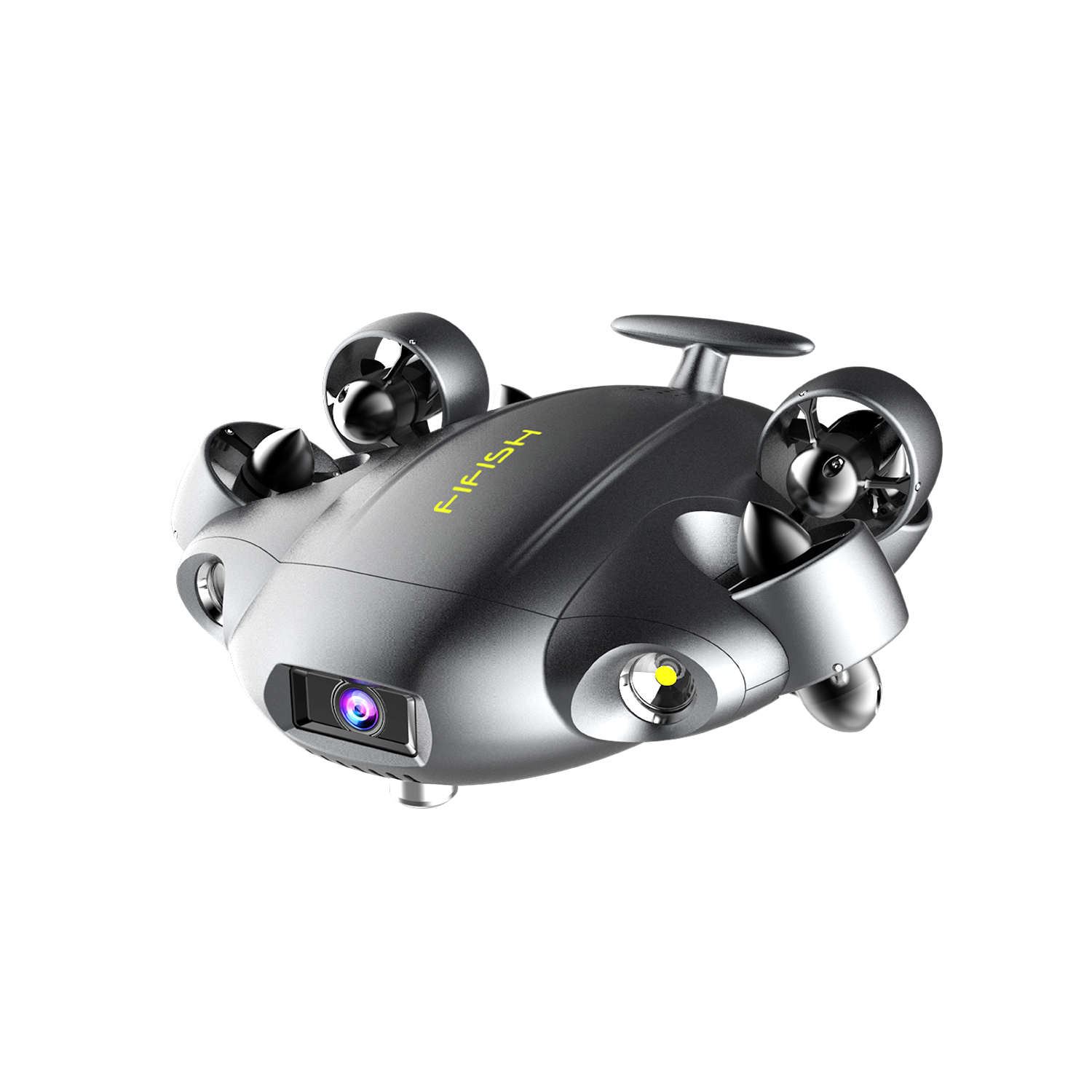
A commercial diver on the Pacific Northwest coast charges $250 to swim under your boat once and hand you a video. A 4K robot rated to 100 meters that will do the same swim as often as you want costs $2,999 and is in stock this morning. Twelve inspections and the robot is paid off. Five trips to the boatyard do the same.
The Machine
The FIFISH V6 EXPERT is a tethered underwater vehicle the size of a carry-on bag. QYSEA sells four packs directly: $2,999 for the standard pack with a 100-meter tether, $3,599 if you want 200 meters of tether, $3,999 for the standard range with a two-finger robotic arm, and $4,298 for both. All four show in stock, with free US shipping and a one-year warranty.
It is rated to 100 meters (328 feet) of depth and moves in six degrees of freedom, which in practice means it can hold an angle and look straight up at a hull instead of swimming past it. The camera is 4K UHD at 12 megapixels behind a 166-degree lens. Two lights put out 6,000 lumens together. It weighs 4.6 kilograms (10.14 pounds), carries 5 kilograms of payload, and tops out at 3 knots. QYSEA rates the battery at one to four hours depending on conditions.
There is a cheaper entry point. The FIFISH V-EVO is $1,399, also rated to 100 meters, 3.9 kilograms, 5,000 lumens, 4K at 60 frames per second, with a 97.2 Wh battery and the same 100-meter tether. It carries 2 kilograms instead of 5 and takes a $1,699 arm pack. For looking at a hull, it is $1,600 less machine that sees the same barnacle.
The Numbers
The comparison is what a working boat owner or a marina actually pays to see underwater today. PNW Diving Services publishes its rates, which most dive outfits do not. Albert Jensen & Sons boatyard at the Port of Friday Harbor publishes its haul-out schedule, effective March 1, 2026.
| Metric | Hire it done | Own the ROV | Source |
|---|---|---|---|
| Vessel inspection with video | $250 per inspection | Included | PNW Diving |
| Mooring inspection with video | $250 per inspection | Included | PNW Diving |
| Dock, float and piling inspection | $250 per hour | Included | PNW Diving |
| General diving services | $200 per hour | Included | PNW Diving |
| Hardware | $0 | $2,999 standard pack | QYSEA |
| Same, with two-finger arm | — | $3,999 | QYSEA |
| Same, with 200 m tether | — | $3,599 | QYSEA |
| Entry-level alternative | — | $1,399 (V-EVO) | QYSEA |
| Depth rating | Varies by diver | 100 m (328 ft) | QYSEA |
| Runtime per charge | — | 1-4 hours | QYSEA |
| Light output | Diver’s lamp | 6,000 lumens | QYSEA |
| 40-ft round-trip haul-out | $560 + $80 fee | Not needed | Port of Friday Harbor |
| Hull cleaning, 40-ft, monthly plan | $80 per visit ($2/ft) | ROV cannot clean | CaliCoast Marine |
| Underwater video from a cleaning diver | DATA NOT AVAILABLE FROM SOURCE | — | CaliCoast Marine |
| Battery draw with lights at full | — | DATA NOT AVAILABLE FROM SOURCE | QYSEA |
| Break-even vs. $250 inspections | — | 12 inspections | Our math |
| Break-even vs. 40-ft haul-outs | — | 5 haul-outs | Our math |
The arithmetic, in the open. Divide $2,999 by the published $250 inspection and the machine pays for itself at 12 inspections. Against hourly work it is 15 hours of general diving at $200, or 12 hours of piling inspection at $250.
The haul-out line is the harder number. A 40-foot boat at Albert Jensen & Sons is $14 a foot round trip — lift, pressure wash, blocking and back in the water — which is $560, plus a $2-per-foot environmental fee, so $640 before Washington’s 8.6% sales tax. If the only reason you are hauling is to look at the running gear, $2,999 buys you five of those trips and then keeps going.
What Breaks
It sees. It does not scrub. This is the honest limit of every ROV at this price. A diver who cleans your hull is already down there looking at it; CaliCoast Marine in San Diego charges $2 a foot on a monthly plan, so a 40-foot boat gets a human under it every three to four weeks for $80. If you are already buying that, you are not buying 12 inspections a year — you are buying zero, and the ROV never pays for itself. The $3,999 arm pack grips 5 kilograms. That retrieves a dropped phone or a lost prop nut. It does not replace an anode or free a fouled line under load.
Your video may not count as a survey. The Coast Guard’s NVIC 01-89 Change 1, signed 30 May 2025 by Rear Admiral W. R. Arguin, does accept remote inspection for underwater surveys in lieu of drydocking — but for classed vessels it says companies “may also elect to use Remotely Operated Vehicles (ROVs) from ACS authorized service suppliers,” and for unclassed vessels it wants the name of the diving company or ROV operator submitted in advance. Buying the hardware does not make you an authorized supplier. For a UWILD, this machine is a tool your surveyor may use, not a substitute for one.
Water clarity beats every spec. The same Coast Guard document sets the real standard: “The water clarity should be sufficient such that the full height of the propeller and the rudder are visible to the diver in a single view.” Six thousand lumens in silty water produces a bright picture of suspended silt. That rule applies to the robot exactly as it applies to the human.
Three knots is not much current. A 4.6-kilogram vehicle with a 1.5 m/s top speed works a slack tide, not a running one. And the tether that keeps it powered and connected is also the thing that wraps around a piling. QYSEA rates runtime at one to four hours, a range wide enough that the real number with lights at full is not published: DATA NOT AVAILABLE FROM SOURCE.
Who Should Buy This
The operator with structures nobody cleans. Docks, floats, pilings, moorings, intakes, net pens, small dams. Nobody scrubs a piling monthly, so nobody is already down there looking at it, and the published rate to send a human is $250 an hour. An organization inspecting a few dozen piles a year clears $2,999 in a single afternoon of work it used to buy.
The fleet, not the boat. One owner with one boat inspects it once or twice a year. That is a six-to-twelve-year payback on a $2,999 machine, and you should not buy it on those numbers. A marina, a charter operation, a workboat fleet or a marine contractor crosses 12 inspections in a month and gets the second benefit that does not show up in the table: you can look on Tuesday because something sounded wrong, instead of booking a diver for Friday.
Not for: anyone whose real problem is fouling rather than information — hire the cleaning and take the free look. Not for turbid harbors and fast tides, where the limit is the water, not the budget. And not for anyone who needs the inspection to satisfy a class society or the Coast Guard without going through an authorized supplier.
The Stack
No affiliate links in this issue. When a link earns us a commission, we always say so. Verdicts are never for sale.
If the job is inspection and the water is deep, the FIFISH V6 EXPERT standard pack at $2,999 is the honest entry: 100 meters, 4K, 6,000 lumens, in stock, free US shipping. Add $600 for the 200-meter tether if you work off structures rather than off a dock.
If you want to pick things up as well as look at them, the arm pack is $3,999 — $1,000 for a two-finger gripper rated at 5 kilograms of payload. Buy it for recovery work, not for maintenance.
If you are testing whether an ROV belongs in your operation at all, the FIFISH V-EVO at $1,399 has the same 100-meter depth rating and 4K camera for $1,600 less. Six inspections at the published diver rate and it is paid off.
And if your boat already gets cleaned monthly, keep paying the diver. The camera you need is already in the water.
We earn nothing on any of these links. That is why the break-even above is 12 inspections and not a slogan.
One machine. All the numbers.
Mondays and Thursdays in your inbox. Free, no spam.