
The Well Has No Power. The RPS 400 Solar Pump Does Not Need It.
Verdict $2,039.99 buys the whole solar pump kit; at a co-op's $6.50 a foot the same money buys 314 feet of new overhead line, which arrives without a pump. Inside a free quarter mile of footage, build the line.
Prices are US list prices at the time of publication. Shipping, duties and local taxes vary by country — check with the manufacturer before ordering.
Wood County Electric Cooperative builds overhead single-phase primary line at $6 a foot. Bury the same wire and it is $9. Clear the right-of-way through light timber and add $5.
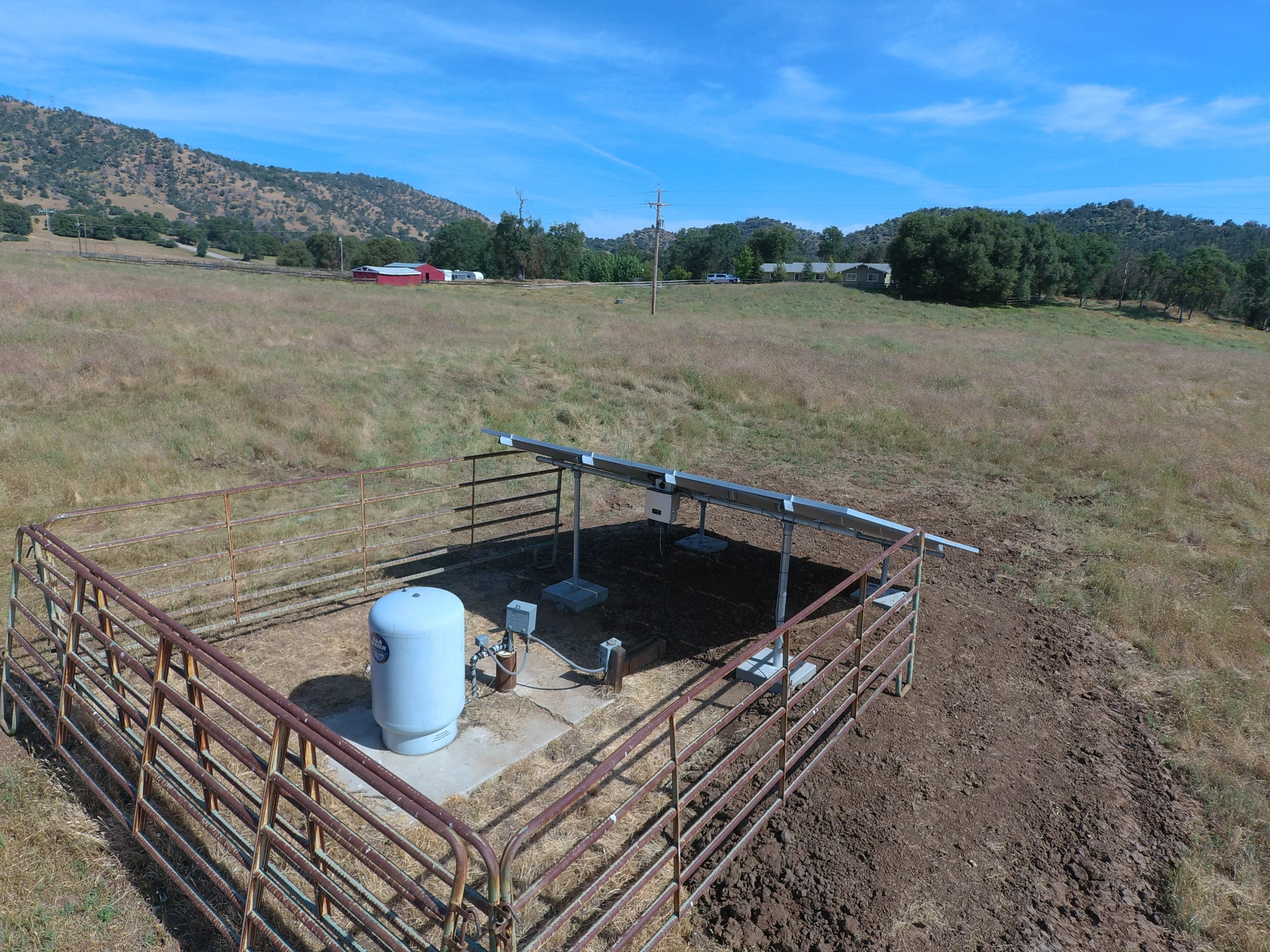
RPS sells a complete solar well pump — pump, controller, four 100-watt panels, sensors — for $2,039.99, with a live Add to cart button. At Pioneer Electric’s $6.50 a foot, the kit costs what 314 feet of new overhead line costs. The line arrives without a pump.
Then read the next line on Pioneer’s page: the first quarter mile is free.
The Machine
The RPS 400 is a helical rotor pump on a DC brushless permanent-magnet motor, wired straight to four 100-watt panels through an RPS controller. No inverter, no battery, no meter. When the sun is up the pump runs. When it is not, it does not.
RPS publishes output “based on a 6 hour solar pumping day”: 2,736 gallons at no head, 1,980 at 100 feet of lift, 1,044 at 225 feet, where the table stops. A low-water sensor and a tank shut-off sensor ship in the box — the two parts that keep a pump nobody is watching from running a well dry or a tank over.
The warranty is lifetime on the rotor — the only wear part, field-serviceable, RPS says — and two years on the rest. The price is a sale: the same page carries a regular price of $3,779.00.
The Numbers
| Item | Figure | Source |
|---|---|---|
| RPS 400 kit, complete | $2,039.99 (regular $3,779.00) | RPS |
| Output at 100 ft and 225 ft of lift | 1,980 and 1,044 gal/day | RPS, 6-hour day |
| Overhead single-phase primary | $6.00 per foot | Wood County EC |
| Underground single-phase | $9.00 per foot | Wood County EC |
| Right-of-way clearing, light timber | $5.00 per foot | Wood County EC |
| Overhead single-phase | $6.50 per foot | Pioneer Electric |
| Free footage, overhead | first quarter mile | Pioneer Electric |
| Monthly meter charge, single-phase | $20, Rate A | Wood County EC |
| 4-inch AC submersible, ½ HP | $449.99 | Runnings |
This is not pump against pump. It is pump against wire. A well 300 feet off the nearest line needs $1,800 of overhead primary at Wood County’s rate before anyone lowers anything into it, $2,700 buried. The kit equals 340 feet of that overhead line, 314 feet at Pioneer’s $6.50, 227 feet buried at $9.00 — and 186 feet once light timber has to be cleared.
Then the wire needs something to run. A half-horsepower, 230-volt submersible lists at $449.99, and the meter it hangs off bills $20 a month on Wood County’s single-phase Rate A before a kilowatt-hour crosses it. That is $240 a year for the privilege of a connection — the whole solar kit every 8.5 years.
None of this is solar bought by the watt. Four hundred watts of panel inside a $2,039.99 kit is $5.10 a watt, against the $1.99 a watt of panel a plug-in balcony kit charges. You are buying a pump that came with its own power plant.
What Breaks
The free quarter mile. Pioneer charges nothing for the first quarter mile of single-phase overhead — 1,320 feet, worth $8,580 at its own rate. If the well sits inside it, the co-op builds the line for nothing and the honest answer is to let it. Wood County goes further in one case: overhead single-phase along a public road is $0 a foot. Policy is written per cooperative — check yours before any arithmetic here means anything. And past the free footage Pioneer’s own worked example bills the wire at 90% of cost over 60 months, $7,722 for the next quarter mile: a payment, not one cheque.
The storage costs more than the pump. A pump that runs only in daylight needs a tank in front of it. A 2,500-gallon vertical water tank runs $2,335.64 — $295.65 more than the kit. Nothing in the $2,039.99 covers it and no break-even above counts it.
Six hours is an assumption, not a spec. Every gallon figure rides on a six-hour pumping day. What the kit moves in January, under cloud, in the northern half of the country is DATA NOT AVAILABLE FROM SOURCE. Panels collect dust, and a pump that stops is a herd without water.
The price is a sale. At the regular $3,779.00 the same kit is 582 feet of Pioneer’s line, not 314.
The wire buys what the pump cannot. A tank heater in January. A light on the pole. A bigger pump later without buying more glass. Grid service is infrastructure; this is one appliance with one job.
Who Should Buy This
The owner whose well is past the free footage. What decides this is not the pump’s price. It is the distance from the last pole, and only the co-op can quote it.
The rotation that already moved off fence. At 225 feet of lift, 1,044 gallons a day waters about 47 lactating 1,300-pound cows at 90°F, on the 22 gallons a head Alabama Extension publishes; at 100 feet, 90 head. Same ground as the collars priced against $15,000 a mile of four-wire fence — which at $2.84 a foot is cheaper by the foot than the power line.
Not for: pressurized household water, which this kit does not do. Not for wells past 225 feet of lift. Not for anyone inside the free quarter mile. And not for anyone who has not priced the tank, because the tank is the bigger cheque.
The Stack
No affiliate links in this issue. When a link earns us a commission, we always say so. Verdicts are never for sale.
Well far from the pole, shallower than 225 feet of lift: the RPS 400 kit at $2,039.99 — four panels, pump, controller, both sensors. Fewer head and a shallower well, and the RPS 200 at $1,939.99 does it on two. Past 300 feet of lift, the Pro Series D at $4,279.99 is where the line ends.
Budget the tank in the same breath: 2,500 gallons at $2,335.64 is what turns six hours of sun into twenty-four hours of water.
Ask your co-op for the footage quote in writing before you buy anything on this page. It is the only number here we could not look up for you.
One machine. All the numbers.
Mondays and Thursdays in your inbox. Free, no spam.