
Degelman Renn's RMC12E Roller Mill Costs 777 Tons of Rolled Corn
Verdict $24,084.00 is 777 tons of corn at the $31.00 a ton Leland Mills adds for rolling and 340 tons at the $71.00 it adds for cracking. Chopping, on the same price list, adds $0.00.
Prices are US list prices at the time of publication. Shipping, duties and local taxes vary by country — check with the manufacturer before ordering.
Leland Mills publishes four prices for a ton of corn. Whole is $439.00. Chopped is $439.00. Rolled is $470.00. Cracked is $510.00.
Same Utah mill, same 2,000-pound tote, all four in stock. The premium for processing a ton of corn there is $0.00, $31.00 or $71.00, depending only on which word you pick off the list.
The cheapest Degelman Renn electric roller mill with 16-inch rolls is $24,084.00.
The Machine
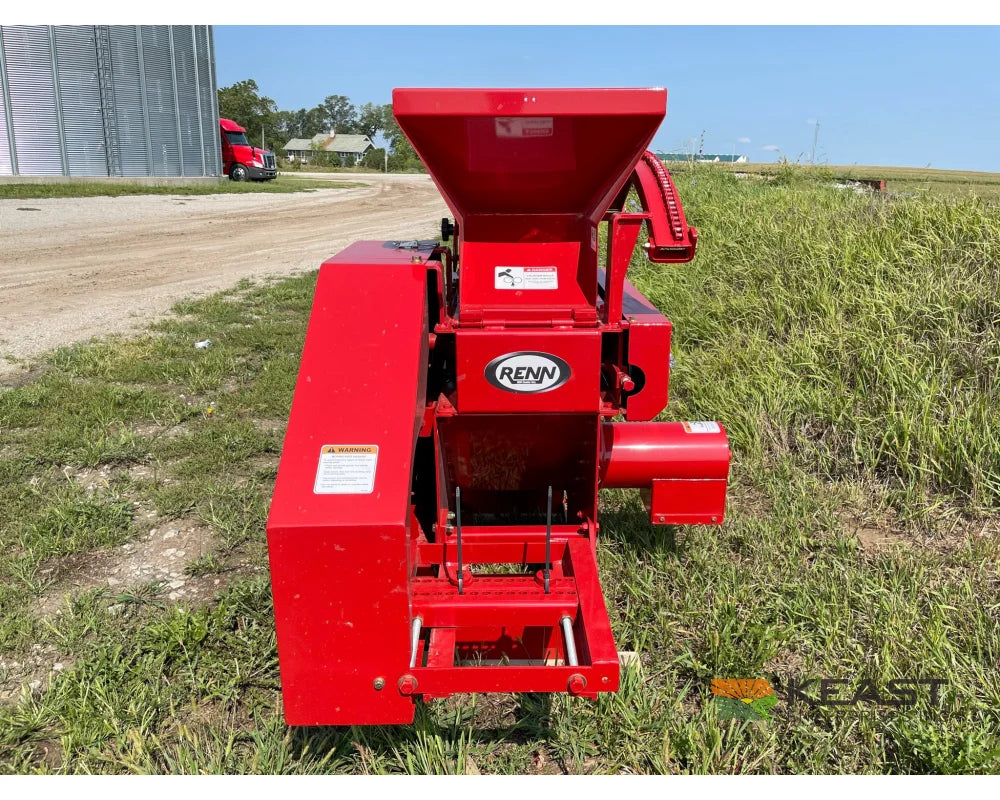
The Degelman Renn RMC12E is a stationary electric roller mill: 16-inch rolls, a 12.5 HP single-phase motor, side discharge. Renn, a division of Degelman Industries, has built this roll diameter for sixty years, arguing a larger roll puts more grain under the same horsepower.
Renn publishes capacity for the RMC 12 at 1,250 bushels an hour in corn, and 500 in wheat, 300 in barley, 250 in oats. At the 56.0-pound bushel that 7 CFR 810.404 sets as the minimum for U.S. No. 1 corn, that is 35.0 short tons an hour.
Stock is real: the Shopify endpoint returns available: true at 2408400 cents, the JSON-LD reads InStock, and the submit button carries no disabled. The two “Sold out” strings in the source are the theme’s hidden badge and its string table.
What the price excludes is on the same page. The dealer asks for “the available voltage and electrical capacity so we can confirm the motor connection, starter and controls, along with any augers needed to feed or unload the mill.” None of those three has a published price. DATA NOT AVAILABLE FROM SOURCE on them, and on weight, dimensions and warranty.
The Numbers
| Line | Figure | Source |
|---|---|---|
| RMC12E, 16” rolls, 12.5 HP | $24,084.00 | Keast |
| Rated corn capacity, RMC 12 | 1,250 bu/hr | Renn |
| Whole corn, 2,000 lb tote | $439.00 | Leland Mills |
| Chopped corn, same tote | $439.00 | Leland Mills |
| Rolled corn, same tote | $470.00 | Leland Mills |
| Cracked corn, same tote | $510.00 | Leland Mills |
| Whole / ground, 2,000 lb | $410.00 / $455.00 | Woods Hay and Grain |
| Whole / cracked, bulk ton | $361.00 / $371.00 | Valley Feed |
| Mill at the rolled premium | 777 tons | Our math |
Three sellers in three states publish both halves — the grain whole and the same grain processed — so the gap between those lines is what each charges to do the mill’s job.
Leland adds $31.00 a ton for rolling, which against $24,084.00 is 777 tons of corn. Cracking on the same list adds $71.00: 340 tons, and 2.29 times the rolling premium for grain out of the same bin. Woods Hay and Grain adds $45.00 to grind, or 536 tons. Valley Feed adds $10.00: 2,409 tons.
In 50-pound bags instead of totes, Leland’s rolling premium falls to $22.00 a ton and the mill goes out to 1,095 tons.
What Breaks
The denominator is a range, and the range decides everything. The break-even on one machine moves from 340 tons to 2,409 depending on whose list you hold. Those are three sellers in three states, so freight and local basis sit inside that gap — the honest comparison is each seller against itself, and even there one page spans $0.00 to $71.00.
Chopped corn costs the same as whole corn. Leland prices it at $439.00 in the 2,000-pound tote, $228.00 at 1,000 pounds and $13.45 in the 50-pound bag — identical to whole corn at all three sizes. If a fine grind is what the animals need, that seller charges nothing for it and no roller mill pays back at all.
Rolled is not quite what this machine makes. Leland describes its rolled corn as “steamed and rolled into a flake,” and a dry mill rolls without steaming. The $31.00 buys steam and rolling, so the share belonging to the rolls alone is smaller: 777 tons is a floor under the question, not an operation’s break-even, and the real figure is larger. The hose crimper report drew the same line — the machine did not replace the hose, it replaced the crimp.
The spec sheet is in bushels and the invoice is in tons. 7 CFR 810.404 sets 56.0 pounds per bushel for U.S. No. 1 corn, 54.0 for No. 2 and 52.0 for No. 3. The same 1,250 bushels an hour is 35.0 short tons of No. 1 and 32.5 of No. 3 — 7.14% of throughput the rating never shows. Renn prints 33.5 t/hr beside those bushels, reconciling with neither the short ton nor the tonne, and its footnote says capacity “will change with moisture, roll configuration, and particle size desired.”
Electricity is not what decides this. At the motor’s rated output of 9.32 kW over 35.0 tons an hour, rolling costs 0.27 kWh a ton; power would have to reach $116.40 per kWh to eat a $31.00 premium. Real draw runs higher and it still does not matter. Not counted above: interest, depreciation, freight, the unpriced starter and augers, roll re-grooving, and labour at zero — the omission the chicken plucker report had to name too.
Who Should Buy This
The feeder who already buys grain by the tote. Someone hauling whole corn home anyway and paying the processing line on the invoice without reading it. That line is the whole argument, and on one of the four products above it is zero.
The operation moving 150 tons a year or more. At that rate 777 tons arrives in the sixth season and the mill runs it in 23 hours. At Valley Feed’s $10.00 it needs 69 hours and 2,409 tons: seventeen seasons.
Not for anyone buying the rating instead of the rolls: the RMC12SC is $2,356.00 less — 10.84% — for a 12-inch roll and 10 HP. Renn lists no RMC12SC; its 12-inch, 10 HP electric rung is the RMC 12S at 25.1 t/hr against the RMC 12’s 33.5, which is 33.47% more corn an hour for the 16-inch machine. Not for anyone whose seller charges nothing to chop. And not for anyone budgeting $24,084.00, because starter, controls and augers are quoted separately.
The Stack
No affiliate links in this issue. When a link earns us a commission, we always say so. Verdicts are never for sale.
Start with the price list, not the catalog: find the whole grain and the processed grain on your own seller’s sheet. Leland Mills and Valley Feed publish theirs in full, and the gap between those lines is the only number that moves this.
Then the machine: the RMC12E at $24,084.00, with the rungs either side on the same page.
Last, Renn’s capacity table and 7 CFR 810.404: one rated in bushels, the other saying what a bushel has to weigh.
Those four corn prices on one page are the whole report. Read a price list before you read a spec sheet.
One machine. All the numbers.
Mondays and Thursdays in your inbox. Free, no spam.