
Jackery HomePower 3000: A $750 Step Up From the 1000 v2 Power Station
Verdict $1,399 against $649: the extra 2,048 Wh costs $366.21 per kWh, and every cheaper step on the ladder ends at this same box. On Jackery's own cycle ratings the 1000 v2 is cheaper per kWh cycled, 10.56 cents to 11.39.
Prices are US list prices at the time of publication. Shipping, duties and local taxes vary by country — check with the manufacturer before ordering.
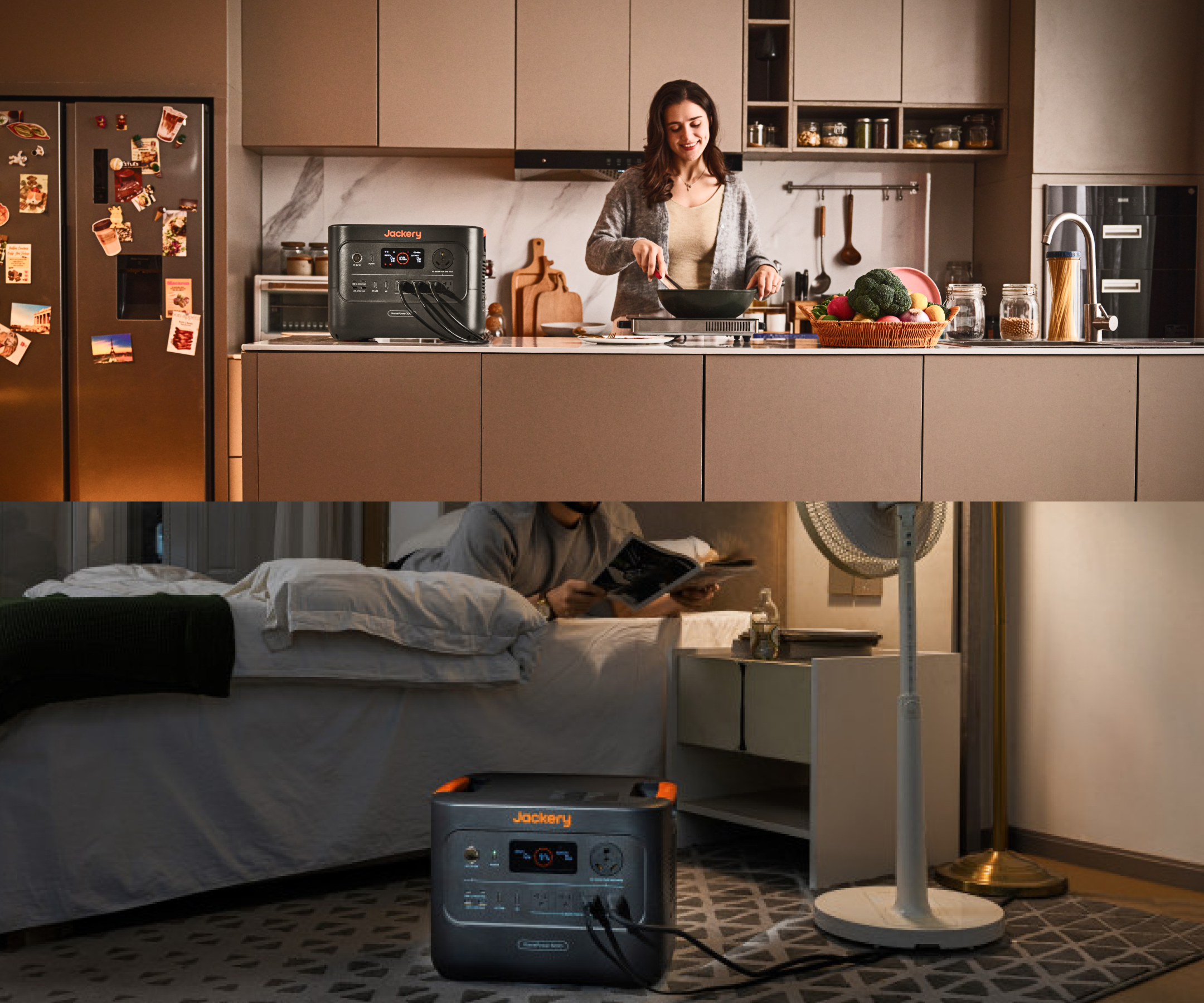
Jackery lists the HomePower 1000 v2 at $649 and the HomePower 3000 at $1,399, both reading "availability":"https://schema.org/InStock" in the store’s own JSON-LD. The step between them is $750.
That $750 buys 2,048 more watt-hours and 2,100 more watts of continuous output. Those watt-hours cost $366.21 each, against $455.40 averaged over the 3000 and $633.79 over the 1000 v2. The one cheaper step on the ladder — $322.27 a kWh, up from the 2000 Plus v2 — ends at this same box; the step below it costs $410.16.
Then read the cycle ratings. Jackery gives the 3000 4,000 cycles and the 1000 v2 6,000-plus. Price divided by lifetime energy: 10.56 cents per kWh cycled for the small box, 11.39 for the big one.
The Machine
The HomePower 3000 holds 3,072 Wh — 60Ah at 51.2V — and delivers 3,600 W continuous with a 7,200 W surge, through four 20-amp outlets and one 30-amp. It weighs 59.52 lbs, and its spec table rates the cells at 4,000 cycles to 70%+ capacity under a 3-year warranty plus 2 free.
The HomePower 1000 v2 holds 1,024 Wh, delivers 1,500 W, switches over in under 10 milliseconds, and claims 6,000+ cycles on the same 3+2 warranty. Jackery publishes no weight for it: DATA NOT AVAILABLE FROM SOURCE.
Every rung is in stock and priced by the maker: 1000 v2 $649 · 2000 Plus v2 $1,069 · 3000 $1,399 · 3600 Plus $1,709 · 3600 Pro Max $1,799. Per kWh of storage the curve runs $633.79, then $521.97, then $455.40 here, then back up to $474.72. It bottoms out at this box.
Three times the storage for 2.16 times the money.
The Numbers
| Item | Figure | Source |
|---|---|---|
| HomePower 3000 | $1,399.00 · 3,072 Wh · 3,600 W · 4,000 cycles to 70%+ | Jackery |
| HomePower 1000 v2 | $649.00 · 1,024 Wh · 1,500 W · 6,000+ cycles | Jackery |
| Manual Transfer Switch, 120V 30A | $399.00 | Jackery |
| Residential kWh, single-phase Rate A | $0.11506 · $20 monthly charge | Wood County EC |
Wood County EC charges 11.51 cents a kWh on its single-phase residential rate — the same tariff sheet that priced a solar well pump against 314 feet of new co-op line. Filling the 3000 therefore costs about 35 cents of stored energy. What the wall gives up to store it is more: Jackery publishes no round-trip efficiency, so that gap is DATA NOT AVAILABLE FROM SOURCE.
Hold on to that. This box does not make electricity and it does not shrink a bill: it stores kilowatt-hours somebody already sold you and hands them back when the line is down. Across its rated 4,000 cycles it will move 12,288 kWh — $1,413.86 of Wood County power, about what the box itself cost. There is no break-even against a utility here, only a price for the container.
What Breaks
Neither box comes with a way into the house. Jackery’s own Manual Transfer Switch is $399, which makes the honest entry price $1,798 for the 3000 and $1,048 for the 1000 v2. Six home circuits is a claim about that switch, not about a box with an extension cord.
The two cycle ratings are not the same measurement. 4,000 cycles to 70%+ capacity sits in the 3000’s spec table. The 1000 v2’s 6,000+ cycles sits in description copy with no capacity floor; what it retains at cycle 6,000 is DATA NOT AVAILABLE FROM SOURCE. One figure is a rating, the other is a claim, and only the rating says what is left in the cells.
Nobody reaches either rating under warranty. One full cycle a day is 10.96 years to 4,000 and 16.44 to 6,000. The warranty is five. Cycled the way a backup box actually is — a handful of times a year — both ratings sit decades out and calendar aging ends it first.
Everything is 120 volts. The 3,600 W arrives through one 30-amp outlet and there is no 240-volt leg, so a 240 V well pump, compressor or dryer does not care how many watt-hours are in the box. That is the job the tractor-driven generator we priced on Saturday does and this one does not. The HomePower ladder’s 240 V rung is the 3600 Pro Max, $400 above this one. Whether a given motor starts on 7,200 W of surge is on its nameplate, not on ours.
Recharging assumes the grid it is replacing. Wall charging is quick, and during the outage there is no wall. Two 200-watt panels put the same box at $1,929 — $530 more — and 400 watts of panel refills 3,072 Wh only across a long clear day.
$1,399 is a marked price. The compare-at figure is $1,499 and the offer carries a priceValidUntil of 2026-09-17. Every ratio above moves if it reverts.
Who Should Buy This
The owner who cannot spare the tractor. Saturday’s report said the PTO generator is wrong for anyone who needs the tractor during the outage. This is the machine that sentence pointed at: unattended, indoors, no engine — the quieter cousin of the battery generator we priced against gasoline in August.
The house whose outage is counted in hours. EIA put the average U.S. customer at 11 hours of interruption across all of 2024. A fridge, a router and lights clear that on 3,072 Wh. A well, a furnace blower and a range for two days do not.
Anyone buying watts rather than watt-hours. If the worst load on the list tops out under 1,500 W, the $750 buys headroom nobody needs and the 1000 v2 cycles cheaper. If something on the list surges — a pump, a saw, a chest freezer coming back on — the 7,200 W is exactly what the money is for.
Not for: anyone hoping for a smaller bill, because everything it hands back was bought first at 11.51 cents. Not for a 240-volt load. Not for anyone who has not priced the $399 switch. And not for a week off grid on the box alone: that is a solar purchase with a battery attached.
The Stack
No affiliate links in this issue. When a link earns us a commission, we always say so. Verdicts are never for sale.
A load list with a surge on it: the HomePower 3000 at $1,399 — 3,072 Wh, 3,600 W continuous, 7,200 W surge, and the low point of the ladder at $455.40 per kWh.
A load list without one: the HomePower 1000 v2 at $649 — 1,024 Wh, 1,500 W, and on the maker’s own ratings the cheaper kilowatt-hour over a lifetime, at 10.56 cents cycled.
Either way, budget the way in: the Manual Transfer Switch at $399 turns a box with outlets into six circuits that come back on by themselves.
Count the watts on your worst night before the watt-hours. The first number picks the box; the second only says how long it lasts.
One machine. All the numbers.
Mondays and Thursdays in your inbox. Free, no spam.