
Lasers Only's CW 2000W Laser Cleaner: 35 Hours of Hired Blasting
Verdict $10,499 is 35 hours of hired mobile blasting at $300 an hour, or 21 callouts at the $500 job minimum. Four of the seven hourly lines on that rate card are materials it is not sold for, and it needs 220-volt single-phase power.
Prices are US list prices at the time of publication. Shipping, duties and local taxes vary by country — check with the manufacturer before ordering.
Green Mountain Mobile Blasting publishes its rate card, which in this trade is rarer than it sounds. Dry-blasting metal is $300 an hour. Small parts carried into the shop are $150. Travel is $75 an hour, round trip. And the truck does not leave Johnson, Vermont for less than a $500 minimum.
A handheld fiber laser takes the metal line off that card without abrasive media. The CW 2000W SUP is $10,499 at Lasers Only, cart live. That is 35 hours of hired blasting — or, counted the way the card bills, 21 callouts.
The Machine
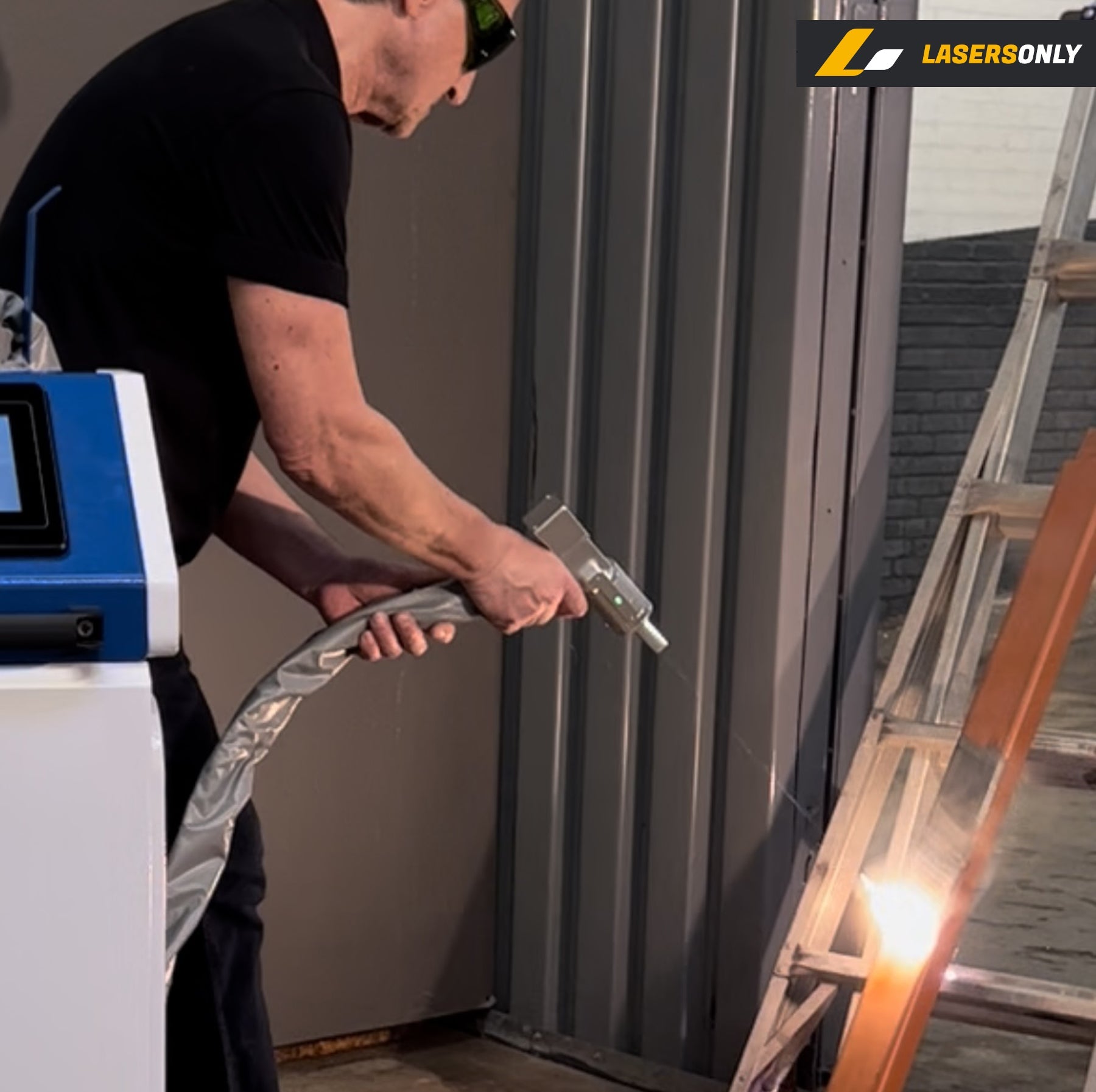
The CW 2000W SUP is a continuous-wave fiber laser on casters: a Raycus RFL-C2000S-CE source rated 2,000 watts at 1080 nm, an SUP22C hand gun, and a water chiller built into the cabinet. Power tunes from 10 to 100%, beam width goes to 300 mm, scan speed to 7,000 mm/s, and the published rate is ”≤ 50 m²/hour.”
It runs on single-phase 220 V, the fiber cable is 33 feet, and the warranty is two years including the laser source, which is the expensive part most sellers carve out. Stock is real: the product endpoint returns available: true at 1049900 cents, the structured data says InStock, and the buy button is not disabled.
The Numbers
Two shops publish hourly rates for this work. Green Mountain is mobile and comes to the job; WildMtn Innovations in Durango blasts in its own building.
| Line | Figure | Source |
|---|---|---|
| CW 2000W SUP | $10,499 | Lasers Only |
| Dry sandblasting, metal, mobile | $300/hr | Green Mountain |
| Small items, in-house | $150/hr | Green Mountain |
| Travel, round trip | $75/hr | Green Mountain |
| Mobile job minimum | $500 | Green Mountain |
| Blast cabinet | $75/hr | WildMtn |
| Clemco system, up to 10 ft | $175/hr | WildMtn |
| Break-even, mobile metal | 35 hours | Our math |
| Break-even, at the job minimum | 21 callouts | Our math |
| Break-even, in-house hour | 70 hours | Our math |
| Break-even, Clemco / cabinet hour | 60 / 140 hours | Our math |
| Machine + goggles + lens pack | $10,638 → 36 hours | Our math |
The hour is not the unit anybody is billed in. Green Mountain prices mobile work “by the hour 90% of the time,” then sets a floor of $500 — 1.67 hours of dry metal blasting, before travel. A bracket that takes forty minutes still costs $500 plus driving. So the honest count is callouts, and the number that matters is 21: the same move as pricing a dockside inspection in visits rather than in hours of diver time.
What Breaks
Thirty-three feet of cable is the whole limit of the argument. The mobile blaster drives to the work; this machine waits for it. The fiber cable is 33 feet, 10 metres in the components diagram; the 20 metres on the Raycus datasheet row is that source’s customizable option, not what ships. The cabinet needs single-phase 220 V at the other end. Anything that cannot come within 33 feet of that outlet has to be moved, which is what the $75-an-hour travel line covers on the other side.
Blasting sells texture. The laser sells clean. Those are different products. Green Mountain says sandblasting “creates a clean and textured surface that significantly improves coating adhesion,” and WildMtn that it leaves “a surface which it can adhere to seamlessly.” The laser’s page claims improved adhesion too — but the same seller’s operating guide explains that the base metal “reflects the laser and remains largely undamaged,” and that the process works “without scratching or thinning the underlying metal.” Leaving the substrate untouched and cutting an anchor profile into it are opposite outcomes, and no surface-roughness figure appears anywhere on the machine’s page: DATA NOT AVAILABLE FROM SOURCE. If your coating spec names a profile, nothing on either page says this machine produces one.
Two lifespans, one website. The product graphic says “Working life is 100,000 hours.” The seller’s own page on source lifespan rates a fiber source “between 50,000 and 100,000 operating hours.” The bigger number is the one printed beside the price.
What the price leaves out is where a laser stops resembling a blaster. Goggles are $69 and a ten-pack of protective lenses $70, both from this seller: honest entry $10,638, or 36 hours. A fume extractor is listed in that same operating guide as a main component of a laser cleaning system and is not sold on the site: DATA NOT AVAILABLE FROM SOURCE. The safety page requires trained operators and names Laser Safety Officers, with no cost published for either. Nor is the power draw — volts and phase, never watts. The blasting rate includes media, compressor and the person holding the nozzle. Interest and depreciation are counted on neither side.
Four of the seven hourly lines stay with the other guy. Masonry is $350, pools $375, wood $400, fiberglass $400. The laser is sold for metals and “some non-metal surfaces,” and names none of those four.
Who Should Buy This
The shop that already called somebody this year. Not the shop that might. Pull last year’s invoices and count visits, because the minimum makes every visit $500 whatever it was for. Twenty-one of them and this is even; four a year is a five-year wait, and that shop keeps the phone number.
The fabricator whose week is ones and twos. The plasma table report closed its buyer list with a condition — “not for a shop without 220V and a real compressor” — and this machine keeps the first half and deletes the second. Trailer and gate work, restoration, anything already on the bench.
Not for: work that cannot come within 33 feet of a 220-volt outlet. Not for a coating spec that names a measured anchor profile. Not for masonry, wood, pools or fiberglass. And not for anyone counting 35 hours who has never counted the callouts.
The Stack
No affiliate links in this issue. When a link earns us a commission, we always say so. Verdicts are never for sale.
If the invoices say twenty-one visits or more, the CW 2000W SUP at $10,499 is the machine those invoices were paying for: 2,000 watts, 33-foot fiber, chiller inside, two years on the source.
Price the CW 1500W SUP at $8,199 beside it first. It is $2,300 less from the same seller — 4.6 of the callouts this whole exercise counts.
Budget the EP-8-6 glasses at $69 as part of the machine: OD 5+, rated across 800–1700 nm, which covers the 1080 nm this thing emits. The listing recommends them for marking machines, so confirm the rating against 2,000 watts.
The protective lens ten-pack is $70 — $7 a lens, the only consumable with a published price. How fast it burns is not published, so log it from the first week.
Then read Green Mountain’s rate card: free, itemised, written by the people this machine is meant to replace.
The seven hourly lines on that card are still seven. This machine takes the metal ones and leaves the phone number in the drawer for the other four.
One machine. All the numbers.
Mondays and Thursdays in your inbox. Free, no spam.