
AccuHatch Pro Cabinet Incubator: 280 Eggs, 305 Chicks to Break Even
Verdict $749.99 against published chick ladders: break-even is 185 Cornish Cross chicks at McMurray's $4.06 and 305 at Myers' $2.46, more than the 280 eggs the cabinet holds. At Freedom Ranger, which sells both, the fertile egg is $2.50 and the hatched chick $1.65.
Prices are US list prices at the time of publication. Shipping, duties and local taxes vary by country — check with the manufacturer before ordering.
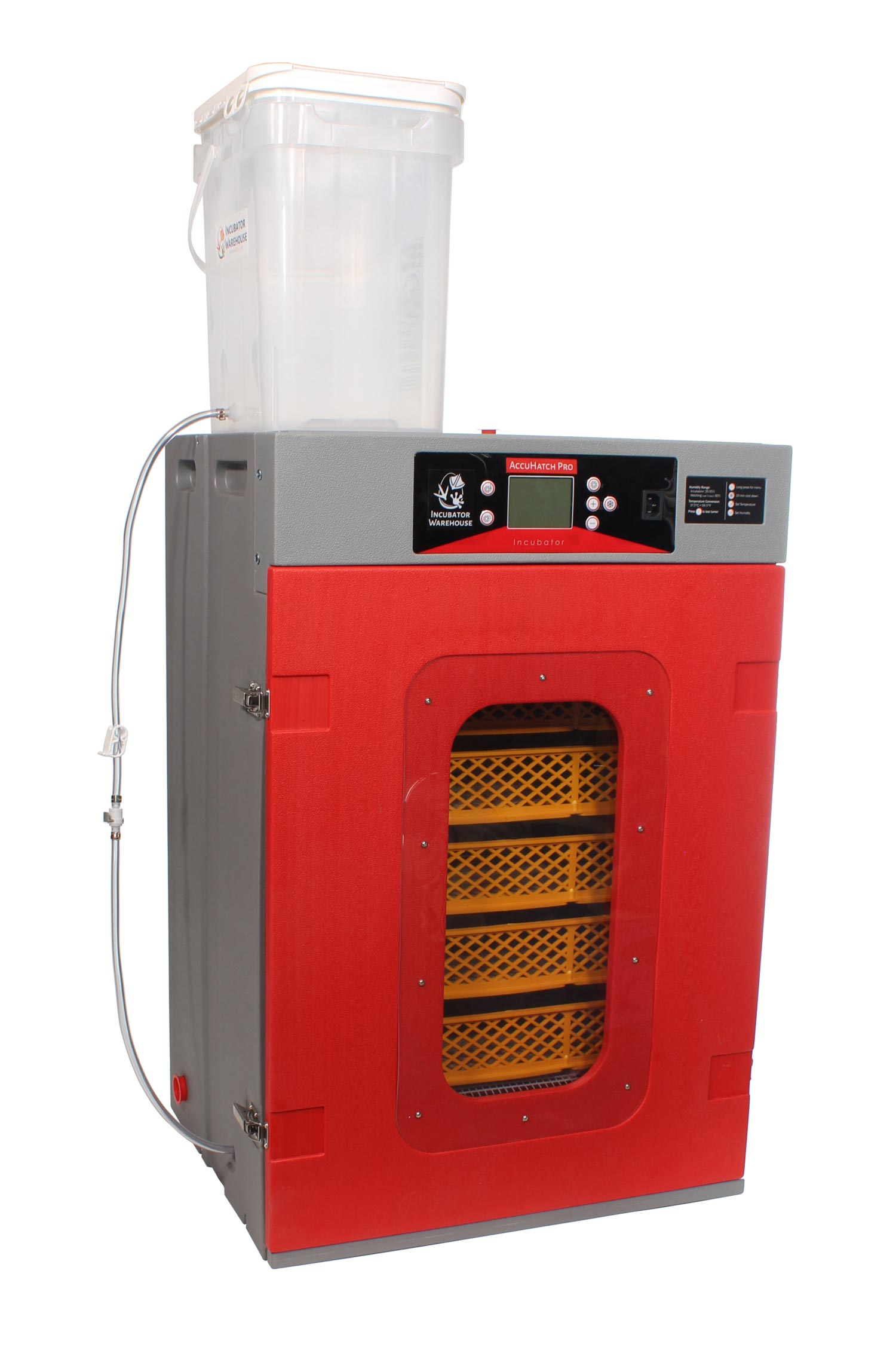
Incubator Warehouse lists the AccuHatch Pro cabinet incubator at $749.99. The cabinet holds 280 chicken eggs.
Three hatcheries publish a quantity ladder for the bird it would replace. Against the cheapest, the machine costs 305 chicks — twenty-five more than it holds in one load.
The Machine
The AccuHatch Pro incubates and hatches in one double-walled plastic box, so eggs never move to a second machine halfway through. Turners are universal, humidity control is automatic, the display reads in Fahrenheit.
It measures 24 by 20 by 30 inches, weighs roughly 55 lb and runs on a 110 V outlet. Rated capacity is 600 quail, 280 chicken or 160 goose eggs, across 95 °F to 104 °F. Warranty is two years.
Per egg of stated capacity that is $2.68 for chickens and $1.25 for quail. SKU 1481, in stock, checked three ways today: the catalog JSON, the variant endpoint reading 74999 cents, and a served page carrying schema.org/InStock beside a live cart button. That endpoint also publishes a compare-at of $899.50, making today’s price a 16.62% markdown on a listing the store tags as excess stock.
The Numbers
| Straight-run Cornish Cross | McMurray | Metzer Farms | Myers Poultry |
|---|---|---|---|
| Smallest rung | $5.25 (1-5) | $5.23 (1-24) | $4.15 (1-24) |
| Rung a full load lands on | $4.06 (100-499) | $2.75 (100-299) | $2.46 (100-299) |
| Largest rung | $3.86 (500+) | $2.28 (600+) | $2.25 (300+) |
| Ladder span, top to bottom | 1.36x | 2.29x | 1.84x |
| Break-even, chicks | 185 | 273 | 305 |
| Share of one 280-egg load | 66.07% | 97.5% | 109% |
| Vaccination | extra | included | $0.22 extra |
All three read as served HTML today: McMurray, Metzer Farms, Myers Poultry. Straight run is the only comparable column: an incubator does not sex.
The spread is the whole report. The same bird, at the volume a full cabinet implies, costs $4.06 at one hatchery and $2.46 at another — a factor of 1.65 — and that ratio alone moves the machine from two-thirds of a load to more than a whole one. At Myers’ 300-up rung of $2.25, break-even is 334.
From the other side: 280 chicks from McMurray are $1,136.80, or 1.52 times the incubator. The same 280 from Myers are $688.80, or $61.19 less than the machine that would hatch them.
What Breaks
The denominator is a bird you are told not to make. McMurray’s page, directly above the ladder: “Jumbo Cornish Cross are hybrids, therefore we do not recommend breeding. They will not produce the same high quality in the next generation and due to the extreme rate of growth they will be too large at time of sexual maturity to breed successfully.” Every break-even above prices a chick this cabinet cannot produce from its owner’s flock. It can hatch the egg. It cannot make it.
So the egg gets bought, and the arithmetic turns over. Freedom Ranger Hatchery sells both halves off one site, for its own slower-growing broiler rather than the Cornish Cross above. Hatching eggs are $29.99 a dozen, or $2.50 an egg; its day-old straight-run chicks are $1.65 at 100 to 499. The unhatched egg costs 1.51 times the hatched, shipped chick. Twenty-five dozen eggs — 300, about one cabinet load — run $749.75: $0.24 below the cabinet and $254.75 above the same 300 birds delivered alive.
280 eggs are not 280 chicks, and the seller never says what the gap is. No hatch rate appears on the listing: DATA NOT AVAILABLE FROM SOURCE. University of Maine Extension reports hatchability “of up to 90 percent” for well-packed shipped eggs — a ceiling, not an average. At that ceiling a full load yields 252 chicks, so the Myers break-even is 1.21 loads.
The published humidity ceiling sits under the published hatching requirement. The listing gives a 30% to 70% range. Mississippi State Extension calls for 58-60% relative humidity until three days before hatch, “increased to 65% relative humidity or more” at hatch. University of Maine puts incubation at 60 to 65% and the last three days at about 75%. The cabinet’s ceiling is five points under that last figure.
McMurray prints two minimum orders on one page and they disagree. Beside the ladder: “Mix & match for 6 chick minimum order.” In the FAQ below: “No, but the minimum order for chicks is 25.” If 25 is the real floor, the $5.25 and $4.99 rungs cannot be ordered, and the dearest chick anyone can buy is $4.74 — a break-even of 159. The two rungs that flatter this machine most are the two you cannot reach.
Nothing on the input side is counted. No break-even above charges the machine for the egg, the power, the brooder or the labour of twenty-one days. The store’s banner offers free shipping over $39, then excludes “ALL Cabinets,” and publishes no freight figure; wattage is absent too. DATA NOT AVAILABLE FROM SOURCE on both. Every number here is a floor.
The seller publishes its own score, and it is 3.31. The listing’s structured data carries an aggregate rating of 3.31 out of 5 across 13 reviews — the vendor’s own number, beside its cart button.
Who Should Buy This
The grower who already keeps a breeding pen. The plucker report was for the grower who already took back the kill day, running 50 to 200 birds a year. This is the far end of that season, and the 185 of the McMurray break-even lands inside that band while the 305 of the Myers one does not. What moved was not the machine. It was which hatchery you call.
The buyer who reads a published ladder from both ends. That was the DTF printer, which broke even at 229 transfers or 553 on order size alone. Same shape here, with one difference: there the ladder belonged to one vendor, and here three vendors publish three that do not agree.
Not for anyone whose freezer bird is a Cornish Cross and nothing else. That chick gets bought every year, from somebody, forever — and at $2.46 it is cheaper than the egg it came from.
Not a cousin of the other $749 reports. Two published prices sit within 10% of this one: the sewer camera at seven rental days and the battery generator at 5-to-1 on running cost. Those settle in single digits; this one in hundreds of chicks. Prices $0.09 apart mean nothing.
The Stack
No affiliate links in this issue. When a link earns us a commission, we always say so. Verdicts are never for sale.
A flock that already lays fertile eggs: the AccuHatch Pro at $749.99, 280 chicken eggs, two years of warranty.
Before that, the ladder it gets measured against, because the ladder decides the answer: McMurray prints seven rungs and three sexes, Myers prints five, Metzer six with vaccination in the price.
And if the eggs get bought rather than gathered, price them first: Freedom Ranger sells hatching eggs and day-old chicks off one counter.
Three ladders, one machine. The only thing that moved between 185 and 305 was whose list was open.
One machine. All the numbers.
Mondays and Thursdays in your inbox. Free, no spam.