
Harvest Right's Medium Freeze Dryer — and the $600 Step That Beats It
Verdict $2,395 buys about 650 pounds of intake a year at one batch a week, or $3.68 a pound. It is the costliest rung on the ladder: the next $600 buys capacity at $1.15 a pound.
Prices are US list prices at the time of publication. Shipping, duties and local taxes vary by country — check with the manufacturer before ordering.
Harvest Right prints the same footnote under all four of its home freeze dryers: the advertised annual figure “would require a person to use the freeze dryer 4 times a week for 50 weeks a year.” That is 200 batches. Push the Medium’s advertised 3,000 pounds through them and every batch has to hold 15 pounds — the exact top of the 10-to-15-pound range printed two lines above it.
At one batch a week, the pace this report used last August to measure the Small at 416 pounds a year, the Medium takes in 650 pounds. It sells for $2,395: $3.68 for every pound it can swallow in a year, and the costliest rung on a four-rung ladder.
The Machine
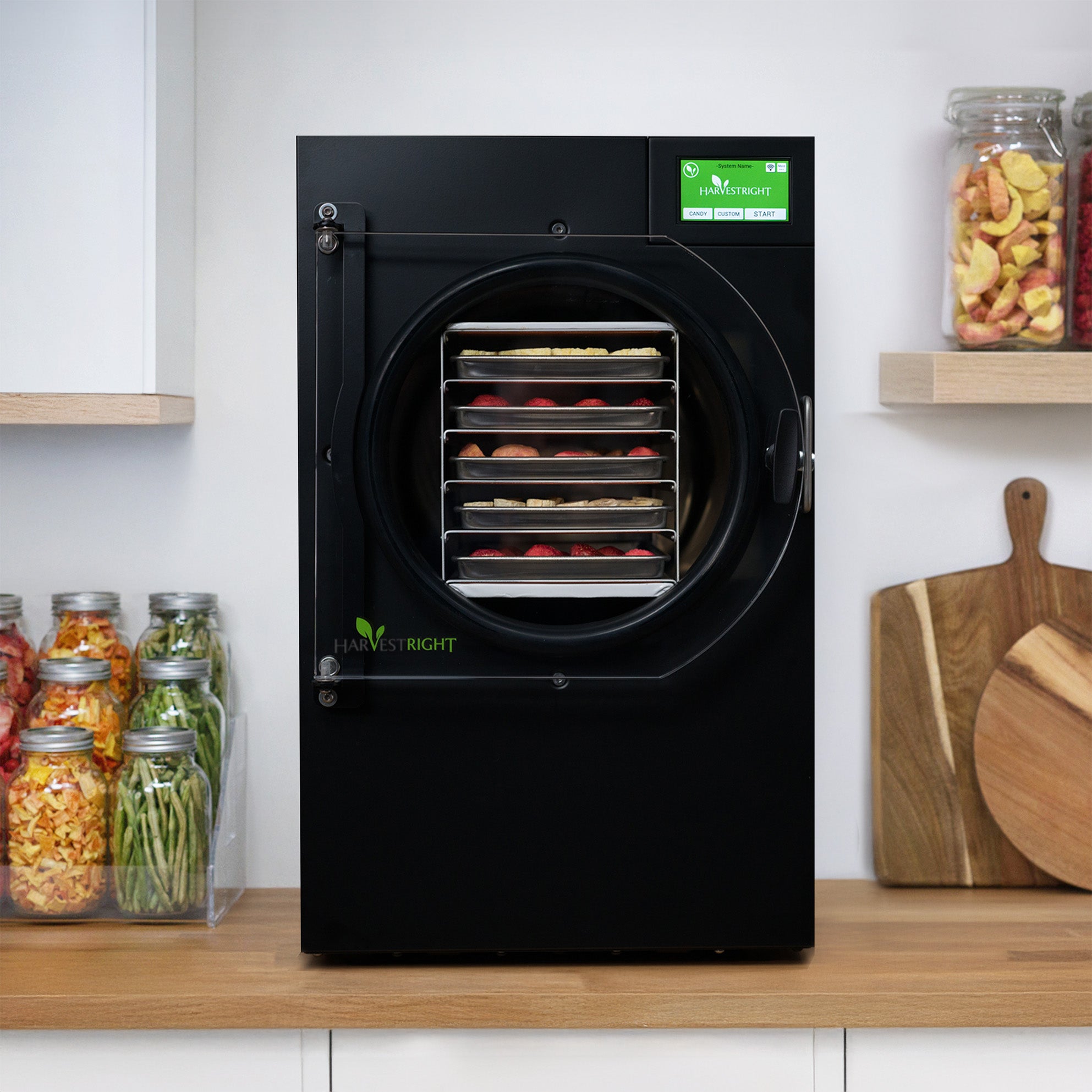
A Harvest Right home freeze dryer is a vacuum chamber with a refrigeration coil and an industrial pump bolted alongside. The Medium holds five stainless trays and 675 square inches of tray space, weighs 119 pounds, and runs on an ordinary 110-volt outlet. Ten to fifteen pounds of fresh food go in per batch, the warranty is three years, and the Premier pump is included.
All four sizes were in stock with a working cart. In base black the ladder reads $1,895, $2,395, $2,995 — and stops, because Harvest Right does not list the X-Large in black at all. Its only listing is stainless, at $4,995. Stainless costs more further down too: the Small in stainless is $2,395, the same money as the Medium in black.
The Numbers
Harvest Right publishes the ladder. Utah State University Extension’s buyer’s guide lists smaller per-batch figures, and attributes them to the manufacturer’s own specifications of the time.
| Rung | Small | Medium | Large | X-Large | Source |
|---|---|---|---|---|---|
| Price, base colour | $1,895 | $2,395 | $2,995 | $4,995 (stainless only) | Harvest Right |
| Per batch, maker | 6–10 lb | 10–15 lb | 18–27 lb | 40–50 lb | Harvest Right |
| Advertised per year | 1,800 lb | 3,000 lb | 5,000 lb | 10,000 lb | Harvest Right |
| Load that claim needs, over 200 batches | 9 lb | 15 lb | 25 lb | 50 lb | Our math |
| Intake at one batch a week | 416 lb | 650 lb | 1,170 lb | 2,340 lb | Our math |
| Price per pound of annual intake | $4.56 | $3.68 | $2.56 | $2.13 | Our math |
| Cost of the step up | — | $500 | $600 | $2,000 | Our math |
| Price per added pound | — | $2.14 | $1.15 | $1.71 | Our math |
The arithmetic, in the open. One batch a week for a year, at the maker’s own mid-range load — 8 pounds, 12.5, 22.5, 45 — and the ladder inverts. The cheapest machine buys the most expensive pounds.
Now price the steps instead of the machines, which is the move that settled a power station against its smaller sibling. The $500 between Small and Medium buys 234 pounds a year, at $2.14 each. The $600 to the Large buys 520 pounds, at $1.15. The $2,000 to the X-Large buys 1,170 pounds, at $1.71.
What Breaks
The footnote is one pace for four different loads. Four batches a week for fifty weeks is 200 batches whatever you buy, so the annual claim is really a claim about loading. The Small needs 9 pounds in a 6-to-10-pound chamber. The Medium needs 15 in a chamber rated to 15, and the X-Large 50 in one rated to 50 — the ceiling, two hundred times, with no week off.
The per-batch figure grew and the price did not. That guide lists the $2,395 Medium at 7 to 10 pounds a batch; today it is sold at 10 to 15. Run the old midpoint, 8.5, at the 3,000-pound year and it needs 353 batches, and the same guide times the cycle at 24 hours of process plus 3 of defrost. That is 9,529 hours against the 8,760 a year holds: the claim overruns the calendar by 32 days.
The cheapest rung is the first one that needs an electrician. The Large wants a dedicated 15-amp circuit and the X-Large a dedicated 20-amp NEMA 5-20. Neither the panel work nor the run is priced anywhere on the page: DATA NOT AVAILABLE FROM SOURCE. Electricity runs $2 to $5 a batch in the figures that guide cites, and it lands on every rung.
These are pounds going in. Neither the maker nor the guide publishes yield, so every figure here is intake, and none of it can be set beside the price of a can of freeze-dried fruit, which is finished weight. Two of the four pumps carry a stated value — $795 on the Medium, $895 on the Large — and two do not, so the step cannot be netted out.
Who Should Buy This
The grower whose crop lands all at once. The maple report named this property: a harvest arriving on a schedule nobody controls. The question is not whether to preserve it but how many pounds turn up in one week, because that picks the rung.
The buyer who was going to stop at the Medium. It is the rung the catalogue steers toward and the one the arithmetic likes least, at any pace: two batches a week doubles every intake figure and halves every price per pound, and all four columns move together. If the outlet takes it and the food exists, the next $600 is the best money on the page.
Not for: the household that will fill four trays and stop, which should be reading the Small’s 416 pounds against a canner. Not for a garage below 45°F in winter. Not for anyone buying the X-Large on the strength of 10,000 pounds a year.
The Stack
No affiliate links in this issue. When a link earns us a commission, we always say so. Verdicts are never for sale.
If food arrives faster than the freezer holds it, the Medium at $2,395 is the rung most buyers land on: five trays, 675 square inches, 10 to 15 pounds a batch, an ordinary outlet.
Price the Large at $2,995 beside it first. Six trays and 1,107 square inches for $600 more is the cheapest capacity Harvest Right sells, and its one condition is a dedicated 15-amp circuit — get that quoted, because it is the only cost here we could not look up for you.
A spare tray set runs $59 to $199 by size — worth knowing before the step gets described as trays. It is not trays: it is chamber, pump and 28 more pounds of machine.
Then read Utah State Extension’s buyer’s guide: free, and written by people with nothing to sell.
Put a scale beside whatever you already use and write down a month of real loads. The rung you can fill is the rung to buy.
One machine. All the numbers.
Mondays and Thursdays in your inbox. Free, no spam.